

Wisdom Tooth Removal in Kolkata
Home > Treatments > Oral & Maxillofacial Surgery > Wisdom Tooth Removal

26
Years of Excellence

NABH
Accredited

60+
Dental Professionals

12K+
Happy Patients

50+
Dental Treatments
Oral & Maxillofacial Surgery
Wisdom Tooth Removal
Oral Cancer Screening
Surgical Teeth Extraction
Jaw Cyst Treatment
Tongue Tie
6292109993
What is Wisdom Tooth Removal?
Wisdom tooth removal is a simple dental procedure to take out impacted or problematic third molars that can cause pain, swelling, or infection. It helps prevent crowding, gum damage, and future oral complications. With proper care, recovery is usually quick and smooth.
Ignoring the discomfort today can lead to bigger dental issues tomorrow—getting it treated at the right time makes all the difference. Visit Smile & Profile Dental Clinic for safe, comfortable wisdom tooth removal by experienced professionals.
Our Clinic Locations
Should You Remove Your Wisdom Tooth? Take the Quiz to Know
How does Wisdom Tooth Extraction Work?
- The dentist examines your tooth with an X-ray to assess its position
- Local anaesthesia or sedation is given to ensure a pain-free procedure
- A small incision may be made if the tooth is impacted
- The tooth is gently loosened and removed (sometimes in sections)
- The area is cleaned, and stitches may be placed if needed
- Gauze is applied to control bleeding and support healing
Types of Wisdom Tooth Extraction
Simple Extraction
- For fully erupted wisdom teeth
- No incision needed
- Quick procedure with minimal discomfort
- Faster healing time
Surgical Extraction
- For impacted or partially erupted teeth
- Requires a small gum incision
- May involve stitches
- Slightly longer recovery
Soft Tissue Impaction Removal
- The tooth is under the gum but not stuck in the bone
- Gum tissue is opened to remove the tooth
- Less complex than deep impactions
Bony Impaction Removal
- The tooth is trapped inside the jawbone
- Bone around the tooth may be removed
- Tooth is often divided into smaller pieces
- More complex, it requires careful healing
Wisdom Tooth Removal vs No Removal: What Should You Do?
| Condition | Removal Needed | Monitoring (No Immediate Removal) |
|---|---|---|
| Pain or discomfort | Yes | No |
| Swelling or infection | Yes | No |
| Impacted or sideways growth | Yes | No |
| Damage to nearby teeth | Yes | No |
| Fully erupted & healthy tooth | No | Yes |
| No pain or symptoms | No | Yes |
| Easy to clean and maintain | No | Yes |
| No signs of decay or gum issues | No | Yes |
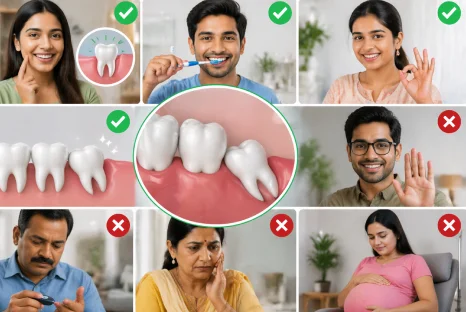
Who Should Avoid Wisdom Tooth Removal?
- No pain or symptoms with a healthy wisdom tooth
- Properly aligned and easy-to-clean teeth
- No infection, swelling, or decay
- Certain medical conditions where surgery is risky
- Uncontrolled diabetes or bleeding issues
- Advised to delay due to pregnancy or ongoing treatment
Timeline of Wisdom Tooth Removal
- Preparation (5–10 minutes) – The dentist administers local anaesthesia to numb the area and ensure a pain-free procedure.
- Tooth Exposure (10–15 minutes) – If the tooth is impacted, a small incision is made in the gum to access it.
- Tooth Removal (15–30 minutes) – The wisdom tooth is gently loosened and removed, sometimes in sections for easier extraction.
- Cleaning & Stitches (5–10 minutes) – The area is cleaned to prevent infection, and stitches may be placed if needed.
- Final Care (5 minutes) – Gauze is applied to control bleeding, and post-procedure instructions are provided for smooth recovery.

After-Care Tips for Wisdom Tooth Removal
- Bite gently on gauze to control bleeding
- Apply an ice pack to reduce swelling
- Avoid hot, spicy, or hard foods for a few days
- Stick to soft foods like yogurt, soups, and smoothies
- Do not rinse, spit, or use a straw for 24 hours
- Maintain oral hygiene but avoid the extraction area initially
- Take prescribed medicines as advised by your dentist
- Avoid smoking or alcohol during the healing phase
- Rest well and avoid strenuous activities for a day or two


Frequently Asked Questions
Can wisdom tooth pain go away without removal?
Mild pain may settle temporarily with medication. But the root cause often remains and can return later.
How to know if a wisdom tooth is impacted?
You may feel pain, swelling, or difficulty opening your mouth. An X-ray confirms the exact position of the tooth.
Can wisdom teeth cause headaches or ear pain?
Yes, impacted teeth can create pressure in nearby areas. This may lead to headaches or ear discomfort.
Will removing wisdom teeth change one’s face shape?
No, the procedure does not affect your facial structure. It only removes the tooth, not the jawbone shape.
What happens if a wisdom tooth grows sideways?
It can push against nearby teeth and cause pain. Removal is often recommended in such cases.