

Dental X-ray in Kolkata
Home > Treatments > Dental Diagnostics > Dental X-ray

26
Years of Excellence

NABH
Accredited

60+
Dental Professionals

12K+
Happy Patients

50+
Dental Treatments
Dental Diagnostics
Dental X-ray
Intra Oral Scanning
6292109993
What is a Dental X-ray?
A dental X-ray is a quick imaging test that uses low levels of radiation to capture detailed pictures of your teeth, gums, and jaw. It helps dentists detect issues like cavities, infections, bone loss, and hidden problems that aren’t visible during a regular check-up.
Think everything’s fine? Your teeth might disagree. Drop by Smile & Profile Dental Clinic for a dental X-ray and know what’s really going on. Book an appointment today.
Our Clinic Locations
Is It Time for Your Dental X-Ray? Answer These Questions to Find Out
How does Dental X-ray Work?
During a dental X-ray, a controlled beam passes through your teeth and jaw, where different tissues absorb the rays at different levels. A sensor captures this pattern to form an image, helping dentists spot hidden issues like decay, infections, or bone changes.
- Dense structures like teeth and fillings block more X-rays, appearing lighter on the image
- Softer tissues allow more rays to pass through, showing up darker
- Digital sensors instantly convert the captured data into clear images
- The entire process is quick, non-invasive, and completed within minutes
- Images can be zoomed or enhanced for a more precise diagnosis
Types of Dental X-rays
Bitewing X-rays
- Detects cavities between teeth early
- Monitors bone loss due to gum disease
- Focuses on the upper and lower back teeth together
- Commonly used during routine check-ups
Periapical X-rays
- Captures the entire tooth from crown to root
- Identifies root infections or abscesses
- Helps in root canal treatment planning
- Detects deep bone or structural issues
Panoramic X-rays
- Shows full mouth, jaw, and surrounding structures
- Useful for wisdom teeth evaluation
- Detects jaw disorders or cysts
- Helps in orthodontic and surgical planning
Occlusal X-rays
- Displays the roof or floor of the mouth clearly
- Tracks tooth development in children
- Locates impacted or extra teeth
- Helps detect fractures or growth issues
CBCT (3D Dental X-ray)
- Provides a detailed 3D view of teeth and jaw
- Essential for dental implants and surgeries
- Maps nerves and bone structure accurately
- Used for complex cases and precise diagnosis
Occlusal X-rays
- Displays the roof or floor of the mouth clearly
- Tracks tooth development in children
- Locates impacted or extra teeth
- Helps detect fractures or growth issues
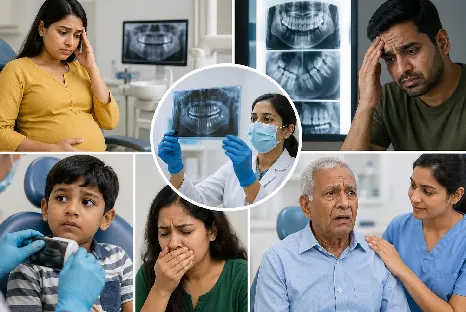
Who Should Avoid Dental X-rays?
- Pregnant women (especially in the first trimester), unless absolutely necessary
- Patients with recent multiple X-rays or radiation exposure in a short time
- Young children, when not clinically required (to limit unnecessary exposure)
- People with severe gag reflex or difficulty holding the sensor (may need alternatives)
- Patients who cannot stay still (as movement can affect accuracy and require repeat scans)
Timeline of Dental X-rays
- Preparation (2–5 minutes): A protective apron is placed, and the sensor/film is positioned in your mouth.
- Positioning (2–3 minutes): You’re guided to bite gently and stay still for accurate imaging.
- Image Capture (Seconds): The X-ray machine releases a quick, low-dose beam to take the image.
- Review (Immediate) : Digital images appear instantly for the dentist to assess.
- Completion (Under 10 minutes): The entire process is quick, comfortable, and done within minutes.


Frequently Asked Questions
How often should you get a dental X-ray?
It depends on your oral health; some people may need them every 6 -12 months, while others may need them less frequently.
Can dental X-rays detect all dental problems?
Dental X-rays help detect hidden issues like cavities, infections, and bone loss, but are usually combined with a clinical examination for a complete diagnosis.
Are dental X-rays safe during pregnancy?
Dental X-rays are generally avoided during pregnancy unless necessary, and special precautions are taken to protect both mother and baby.
Can children get dental X-rays?
Yes, but only when necessary. Dentists take extra precautions to ensure minimal exposure.
Can dental X-rays detect wisdom tooth problems?
Yes, they help identify impacted or misaligned wisdom teeth and related complications.