

Implant Overdentures in Kolkata
Home > Treatments > Implantology > Implant Overdentures

26
Years of Excellence

NABH
Accredited

60+
Dental Professionals

12K+
Happy Patients

50+
Dental Treatments
Implantology
Implant Overdenture
Dental Implants
All-on-4 Dental Implants
All on 6 Dental Implants
6292109993
What are Implant Overdentures?
Implant overdentures are removable dentures that are securely supported by dental implants placed in the jaw. Unlike traditional dentures, they snap onto implants, offering better stability, comfort, and chewing efficiency. They reduce slipping and help preserve jawbone health over time.
Looking to upgrade from loose, uncomfortable dentures to something that actually feels secure? At Smile & Profile Dental Clinic, implant overdentures are designed to give you stability, comfort, and the confidence to smile and eat without worry. Book your consultation today.
Our Clinic Locations
How do Implant Overdentures Work?
Dental implants are placed into the jawbone, acting as strong anchors for the denture. The overdenture then securely attaches to these implants using special connectors, ensuring a firm fit while still being removable when needed.
- Implants are placed in the jawbone to act as anchors.
- They fuse with the bone to create a strong base.
- Attachments are added to hold the denture in place.
- The overdenture snaps on securely but can be removed for cleaning.
- It stays firmly in place while eating and speaking, reducing movement.
- You can easily remove it for daily cleaning and maintenance.
Types of Implant Overdentures
Bar-Retained Overdentures
- A metal bar connects multiple implants
- Denture clips securely onto the bar
- Offers strong stability and even pressure distribution
Ball-Retained (Locator) Overdentures
- Each implant has a ball-shaped attachment
- Denture snaps onto these attachments
- Simple design with easy maintenance
Magnetic Overdentures
- Magnets placed on implants and dentures
- Helps in easy placement and removal
- Ideal for patients with limited hand control
All-on-6 with Zirconia
- Uses durable, natural-looking zirconia prosthetics
- More resistant to staining and wear than acrylic
- Offers long-lasting, strong results
- Ideal for patients looking for a durable and aesthetic solution
Who Should Consider Implant Overdentures?
- People with loose or unstable dentures
- Those wanting better chewing and speech
- Patients with complete or multiple tooth loss
- Individuals seeking a secure yet removable option
- Anyone looking for more comfort and confidence

Comparison Between Traditional Dentures and Implant Overdentures
| Feature | Traditional Dentures | Implant Overdentures |
|---|---|---|
| Stability | Can slip or move while eating/speaking | Firmly anchored to implants |
| Comfort | May cause gum irritation | More comfortable with less gum pressure |
| Chewing Ability | Limited chewing strength | Improved chewing efficiency |
| Fit | May loosen over time | Secure, snug fit |
| Bone Health | Does not prevent bone loss | Helps preserve jawbone |
| Maintenance | Easy to remove and clean | Removable but needs care around implants |
| Longevity | Needs frequent adjustments/replacement | Longer-lasting with proper care |
| Confidence | May affect confidence due to movement | Better confidence while speaking and smiling |

Who Should Avoid Implant Overdentures?
- Patients with insufficient jawbone density (without bone grafting)
- People with uncontrolled diabetes or systemic health conditions
- Heavy smokers (can affect healing and implant success)
- Individuals with poor oral hygiene habits
- Patients not fit for minor oral surgery
- Those looking for a completely fixed (non-removable) solution
Timeline of Implant Overdentures
- Consultation & Planning (Week 1–2) – Examination, scans, and treatment planning
- Implant Placement (Week 3–4) – Implants are surgically placed in the jaw
- Healing Phase (2–4 Months) – Implants fuse with the bone (osseointegration)
- Attachment Placement – Connectors are fixed onto the implants
- Overdenture Fitting – A custom denture is securely attached
- Follow-Up Care – Regular check-ups and maintenance
How Long Do Implant Overdentures Last
Implant overdentures typically last 8–10 years, while the implants themselves can last 20+ years or even a lifetime with proper care.
- Implants – 20+ years (often lifelong)
- Overdenture (prosthesis) – Around 8–10 years
- Attachments (clips/locators) – 1–3 years before replacement
- Regular care helps maintain longevity and performance
After-Care Tips for Long-Lasting Results
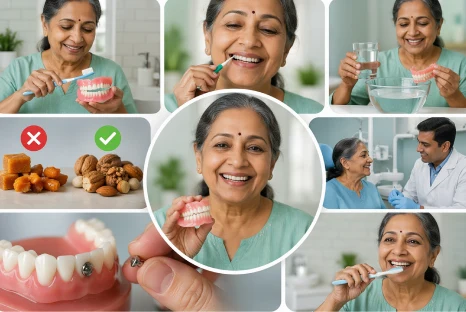
- Clean your overdenture daily to prevent plaque buildup
- Brush around implants with a soft brush or interdental brush
- Remove and rinse the denture after meals
- Avoid hard or sticky foods that can damage attachments
- Visit the dentist for regular check-ups and adjustments
- Replace worn-out attachments (clips/locators) on time
- Maintain good overall oral hygiene habits for long-term success


Frequently Asked Questions
Do implant overdentures feel like real teeth?
Implant overdentures offer significantly better stability than traditional dentures. While they don’t fully replicate natural teeth, most patients find them comfortable and natural in function.
How many implants are needed for overdentures?
Typically, 2 implants are used for the lower jaw and 4 or more for the upper jaw. The exact number depends on bone quality and treatment goals.
Are implant overdentures better than traditional dentures?
Implant overdentures provide superior stability, comfort, and chewing efficiency compared to traditional dentures. This leads to improved overall quality of life.
Can implant overdentures fail?
While rare, failure can occur due to infection, poor oral hygiene, or smoking. Regular follow-ups significantly reduce this risk.
Will implant overdentures change your speech?
Initially, a minor speech adjustment may be needed. Most patients adapt quickly and experience improved clarity compared to loose dentures.