

Intra-Oral Scanning in Kolkata
Home > Treatments > Dental Diagnostics > Intra-Oral Scanning

26
Years of Excellence

NABH
Accredited

60+
Dental Professionals

12K+
Happy Patients

50+
Dental Treatments
Dental Diagnostics
Intra Oral Scanning
Dental X-ray
6292109993
What is Intra-Oral Scanning?
Intra-oral scanning is a modern digital technique used to capture highly accurate 3D images of your teeth and gums—without messy impressions. It uses a small handheld device to scan your mouth comfortably, helping dentists plan treatments like crowns, aligners, and implants with precision.
At Smile & Profile Dental Treatment Centre, advanced intra-oral scanning makes your dental experience quicker, cleaner, and far more comfortable. Get precise, personalised care designed around your smile. Book a consultation today.
Our Clinic Locations
How does Intra-Oral Scanning Work?
A small handheld scanner glides over your teeth, capturing thousands of images in seconds to create a precise 3D model. The result shows up instantly on screen, helping your dentist plan your treatment faster, cleaner, and far more accurately.
- Quick and comfortable—no messy impressions involved
- High accuracy for better-fitting treatments
- Instant digital results you can see on screen
- Saves time with fewer repeat scans or corrections
- Helps plan treatments like aligners, crowns, and implants more precisely
- Makes your overall dental visit smoother and more efficient
Types of Intra-Oral Scanning
Confocal Scanning
- Captures sharp images at different depths for high accuracy
- Works well even without heavy surface preparation
- Ideal for detailed restorations like crowns and bridges
Triangulation Scanning
- Uses light and angles to map the tooth surface
- Known for fast image capture
- Best suited for straightforward dental cases
Active Wavefront Sampling (AWS)
- Captures continuous data even with slight hand movement
- Reduces chances of distortion during scanning
- Helpful for full-arch scans and complex cases
Optical Coherence Tomography (OCT)
- Goes beyond surface—captures subsurface details
- Helps detect early structural changes
- Used in advanced diagnostic scenarios
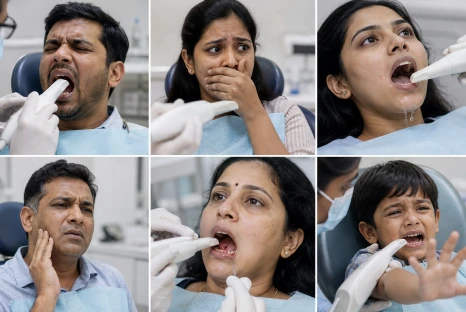
Who Should Avoid Intra-oral Scans?
- Patients who struggle to keep their mouths open for a few minutes
- Individuals with a severe gag reflex or high dental anxiety
- Cases with excessive saliva or uncontrolled moisture in the mouth
- Patients with limited mouth opening due to jaw conditions
- Situations involving heavy bleeding or active oral issues
- Very young children who may not stay still during the scan
Timeline of Intra-oral Scans
- Preparation (1–2 minutes): Teeth are dried, and the area is prepped for a clear scan
- Scanning Process (3–5 minutes): The handheld scanner moves across your teeth to capture detailed images
- Real-Time Display (Instant): A 3D model appears immediately on screen
- Review & Adjustments (2–3 minutes): Dentist checks accuracy and rescans if needed
- Treatment Planning (Same visit): Digital data is used to plan crowns, aligners, or implants


Frequently Asked Questions
Is intra-oral scanning suitable for sensitive teeth?
Yes, it’s gentle and doesn’t involve pressure or materials. This is perfect for patients who usually feel discomfort with impressions.
Can intra-oral scans replace X-rays?
No, they capture only the outer structure of teeth. X-rays are still needed to check deeper issues.
Can intra-oral scanning be used if you have braces or caps?
Yes, scanning works well even with existing dental work. It helps in planning further treatments more accurately.
Does saliva affect the intra-oral scan quality?
Excess saliva can interfere slightly with clarity. Dentists manage this easily during the process.
Can intra-oral scans help in cosmetic dentistry?
Absolutely, intra-oral scans are widely used for smile designing. It helps achieve more predictable aesthetic results.